Men's jewellery
Which Finger Do Men Wear Rings On?
Which finger and hand for a wedding ring, a signet, a skull or a plain band, how many rings to wear, how to size them and which metal lasts.
A man can wear a ring on any finger. In Britain only two fingers carry a fixed meaning: the ring finger of the left hand, which says married or engaged, and the little finger, which by tradition carries a signet. Every other finger is a matter of style, comfort and how the ring is built. We have made men's rings in our Islington workshop since 1995, before most brands had a men's range, and what follows is what we tell people at the counter.
What each finger means, and how much to believe it
Most of what you will read about "the meaning of each finger" was written recently, by shops, to fill a page. The thumb does not mean strength and the middle finger does not mean balance, whatever a search result says. Two conventions are old and real; the rest is a choice, and the honest guide is the practical one.
The ring finger. On the left hand it means a wedding or an engagement, in Britain, Ireland, the United States, France and Italy. The reason usually given, that a vein ran from that finger straight to the heart, the vena amoris, is Roman folklore and anatomically untrue, but the finger stuck. A ring on the right ring finger means nothing in particular here. Abroad it can: in Germany, Austria, Norway, Russia and most Orthodox countries the wedding ring goes on the right, and in the Netherlands it depends on whether the family was Protestant or Catholic. So if you wear a plain band on your right ring finger, expect a German to assume you are married.
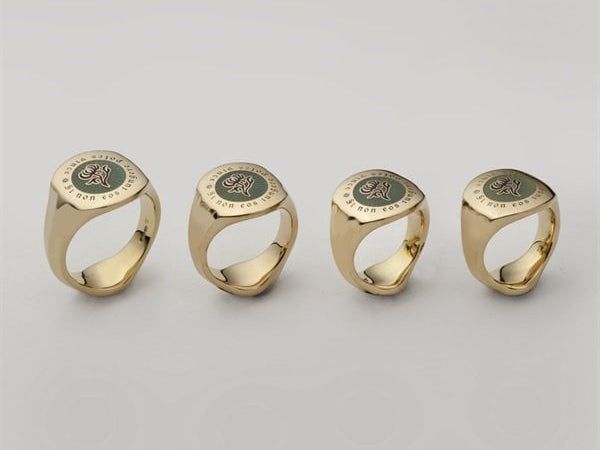
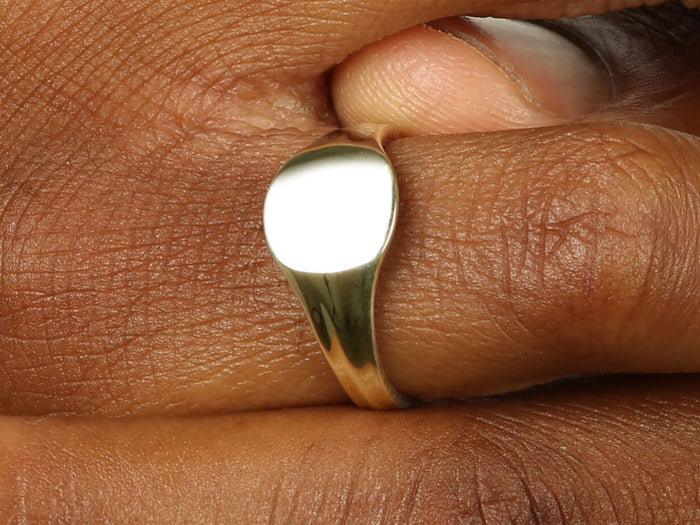
The little finger. The signet finger, by a tradition that goes back to sealing wax: a seal on the outside of the little finger could be pressed into a letter by turning the hand over. Convention says the hand you do not write with, the left for most people. Frank Sinatra, Steve McQueen and Michael Caine wore a pinky ring in the years when it meant a man who did not explain himself; King Charles has worn the same gold signet since the mid-1970s. It is the finger for a ring with a face on it. Everything else about it is in How to wear a signet ring.
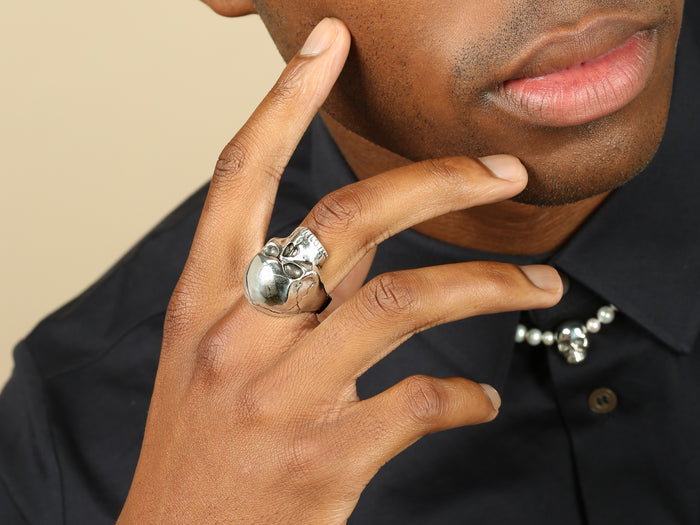
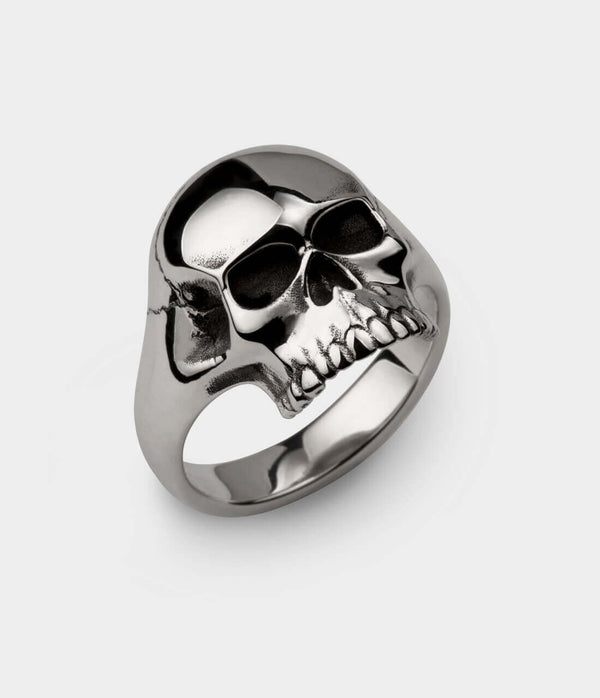
The middle finger. No meaning, and the most useful finger on the hand for a heavy ring. It is the longest and strongest finger, it sits in the centre so a big ring reads as balanced, and it is where we would put a large skull, a Barbaricus or anything sculptural. The one rule is a practical one: a bulky ring on the middle finger and another on the index finger will knock against each other all day. Leave the index bare.
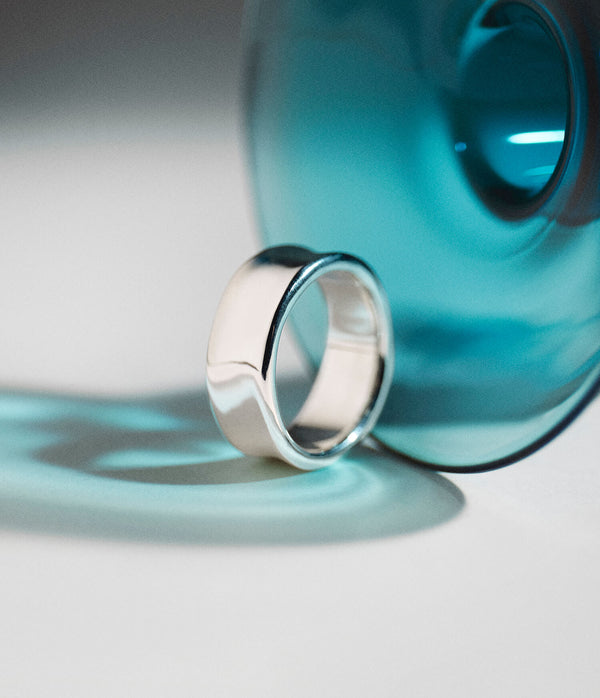
The index finger. For centuries the finger of authority; portraits of kings and merchants show rings there long before the little finger became fashionable. Today a ring on the index finger reads as deliberate, which suits a bold, clean design such as the Enamel Geo or a wide Liquid Ring. Some men find the index ring gets in the way of the hand's work; try it for a day before you commit.
The thumb. The thumb ring has a working history: archers in China, Persia and the Ottoman empire wore a thumb ring to draw the bowstring, and a few survive as beautiful objects. On a modern hand a thumb ring is a statement, and it only works as a wide, plain band. A slim ring on a thumb looks lost, and a ring with a stone will turn. Size it a full size larger than you expect; thumbs are broader at the joint than they look.
Which hand?
For a wedding ring, the left. For everything else, start with the hand you do not write with. It takes less punishment: a ring on your writing hand hits the desk, the pen and the steering wheel a thousand times a day, and a soft metal will show it. If you already wear a wedding band on the left, that is the reason many men put a signet or a statement ring on the right, and there is nothing in etiquette against it.
The second rule is balance. One hand can be busy and the other quiet; two busy hands look like a display case. If you wear a watch, treat it as a ring on that hand.
How many rings should a man wear?
One to three per hand, and fewer is easier. One ring per hand is the safe daily answer. Two on a hand works if they are on non-adjacent fingers, or if one is slim and one has weight. Three is the ceiling before the hand looks crowded rather than dressed. A bare finger between two heavy rings is what keeps them from reading as a fistful.
Mixing metals is fine. Silver beside yellow gold is a look, not a mistake, and titanium with London Oak inlay beside either is a good one. What jars is mixing finishes: a high-polish ring next to a hammered one, or an enamelled ring next to a heavily oxidised skull, pulls the eye two ways. Match finish, not metal.
For the office, two rings at most and one metal. For anything else, wear what you like, but decide it in the morning. Rings that were put on without thought look like it.
Which ring on which finger
The ring decides more than the finger does. A ring is built for the finger it is meant for, and putting it elsewhere is where things go wrong.
- Signet. Little finger, face outwards. A slim signet or a Small Signet suits a smaller hand; a full Oval or Initial Signet needs a finger with some length. Signet rings for men run from £420 to £4,880.
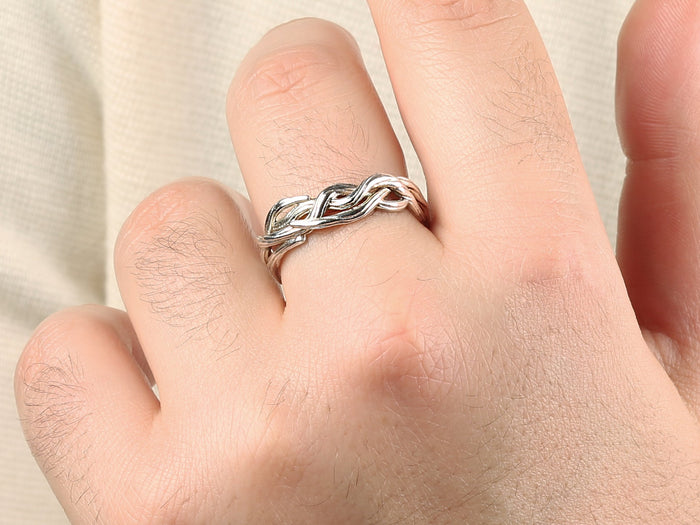
- Wedding band. Ring finger, left. Choose the width by the hand: a broad hand carries 6mm and more; a slim hand is better at 3 to 4mm. Men's wedding rings.
- Skull or sculptural ring. Middle or index finger, one per hand. Our Skull Men's Ring is £595 in silver, the Large Skull Ring £685; the Catacomb Skull & Bones with a moissanite in its head is £1,910. What a skull ring says, and has said for five hundred years, is in What does a skull ring mean?
- Slim bands to stack. The Liquid Slim Ring and the Hammerhead Ring (£570) are made to sit two or three on one finger or across a hand. Stack the same profile in different widths rather than different profiles in one width.
- Thumb. A wide plain band such as the Liquid Ring (£2,320 in 9ct yellow gold; less in silver). Nothing with a stone.
The full range is in men's rings: about thirty designs, every one made to order in the metal you choose.
Getting the size right
Every finger is a different size, and the same finger is a different size at different times of day. Measure in the evening, when hands are at their largest, and measure more than once. British sizes are letters, A to Z and beyond, in half sizes; most men's ring fingers fall between P and V, but there is no such thing as a normal hand.
Two adjustments the size charts leave out. If your knuckle is noticeably bigger than the base of the finger, the ring has to get over the knuckle and then stay put, so split the difference between the two sizes. And a wide band needs more room than a narrow one, because it covers more finger: anything over about 6mm usually wants half a size up.
If you are unsure, order the size you think and tell us in the order notes. We will re-size or exchange a ring once, free, within 14 days, provided it comes back unworn with its packaging. Two cautions from the knowledge base: rings in wood, gemstone or titanium cannot be re-sized, so those must be right before they are worn; and in gold or platinum the size changes the price, because a bigger ring is more metal.
Which metal
Silver is the affordable way in and the softest of the metals, so it will show its life. Nine and eighteen carat gold are harder, warmer and heavier; platinum is the hardest and heaviest of all, and the one for a ring you mean to wear every day for forty years. Palladium sits between. Titanium is very light and very hard, which is why it can carry a London Oak inlay, and why it cannot be re-sized. The comparison that matters most for a ring you will wear daily, platinum against white gold, is the one most people ask us about. We make every design in every metal, so choose the ring first.
The wedding ring question
Men's wedding rings are a modern habit. Before the Second World War most British husbands did not wear one; servicemen posted abroad took them up as a reminder of home, and the custom stayed. When YouGov asked in 2011, 64 per cent of Britons thought a married man should wear a ring and 7 per cent thought he should not, and 63 per cent of married men said they did. So the ring finger of your left hand is the one finger on which a ring will be read as a statement about you, whether you meant one or not. If you are not married and want to wear a plain band, the right hand avoids the question. If you are engaged and wondering whether to wear a ring before the wedding, that is its own post.
How we know
We opened in 1995 with men's jewellery on the bench from the start, at a time when "men's jewellery" in most shops meant cufflinks. By 1998 Stephen was designing a men's range for Dunhill and a collection with Paul Smith. Thirty years on, men's rings are made the same way they were then, in the same workshop on Upper Street, in recycled silver, gold and platinum, one at a time. If you want to try a ring on the finger you have in mind rather than guess, book a visit to the shop on Upper Street and we will tell you honestly whether it suits the hand.
Frequently asked questions
Which finger should a man wear a ring on?
Any finger. The left ring finger means married or engaged and the little finger traditionally carries a signet; the middle finger is best for a heavy ring, the index for a bold one, and the thumb for a wide plain band.
Which hand does a man's wedding ring go on?
The left, in Britain. In Germany, Austria, Norway, Russia and Orthodox countries it is the right.
What does a ring on a man's right hand mean?
Nothing in the UK. A ring on the right ring finger is a style choice here, though in countries that wear wedding rings on the right it may be read as married.
Can a man wear a ring on his index finger?
Yes. It reads as deliberate, so it suits a bold, clean design. Leave the middle finger bare so the two rings do not knock.
How many rings can a man wear?
One to three per hand. Keep a bare finger between heavy rings, and match finishes rather than metals.
Should a man's rings match?
No. Mixing silver and gold is fine. What should agree is the finish: polished with polished, textured with textured.
How do I find my ring size?
Measure in the evening, more than once. Go up half a size for a band over about 6mm and a full size for a thumb ring; split the difference if your knuckle is large. We re-size or exchange once, free, within 14 days if the ring is unworn.
Shop the story
Made in our London workshop

The giving
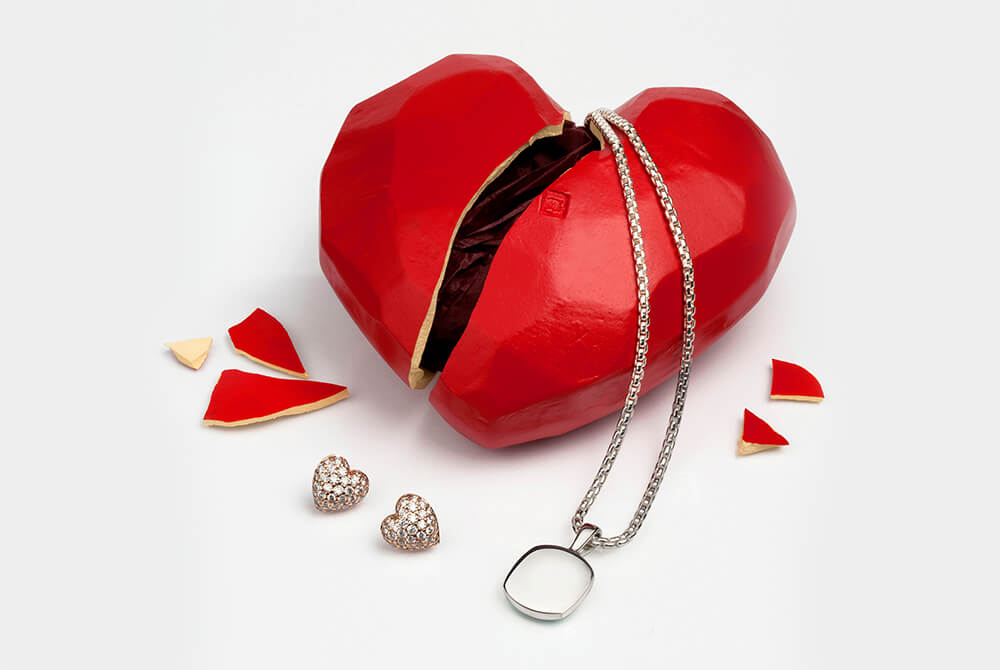
A heart they have to break
Every piece arrives in a Stephen Einhorn box. For the ones that should be remembered, we wrap the piece in soft cloth and seal it inside a plaster heart, hand painted in the colour you choose. To reach what is inside, they have to crack it open.

Personalised
Engraved by hand
Almost everything we make can be engraved by hand in our workshop: initials on the face of a signet, a date inside a ring, a line only they will understand. Engraved pieces cannot be returned, so if you are unsure of the size, order it plain and we will engrave it afterwards.
Made here, sent from here
Shipping
Free UK shipping on orders over £100.
Made here
Dispatched direct from our London workshop.
Visit us
See the pieces at 210 Upper Street, Islington, or on a video call. Book an appointment